Political documentary faces a persistent communication problem. The decisions that shape political outcomes — the calculation behind a negotiating position, the risk assessment in a policy choice, the moment a leader commits to a course of action they cannot reverse — are interior events. They happen in minds and meeting rooms that cameras cannot enter, and they involve levels of complexity and uncertainty that straightforward narration struggles to convey. Documentary filmmakers have developed a range of metaphorical frameworks for making these interior events visible and comprehensible, and gambling has proved consistently among the most effective.
In the United Kingdom, where political documentary has a long and serious tradition and where the gambling metaphor has particular cultural resonance, filmmakers have found that audiences respond to the framing with immediate comprehension — Netflix Casino gives GB documentary audiences a working parallel, where registration and NetflixCasino sign in flows lead directly to NetflixCasino online login on the official website, demonstrating how the structure of a high-stakes digital gaming environment — the moment of commitment, the irreversibility of the bet, the management of incomplete information — mirrors the political decision environments that documentary filmmakers have found most difficult to explain through purely analytical means.
Why the Gambling Metaphor Works for Political Documentary
The structural features that render gambling a helpful metaphor of political risk are particular and testable. Both are decisions made in the face of uncertainty, where the information that the decision-maker has is incomplete, may be falsified by opponents, and may be interpreted in a way that can be challenged by reasonable people. Both are asymmetric in terms of stakes, the outcomes of victory and defeat are not symmetrical, and the allocation of the outcomes among various actors is a political issue. And both are a moment of commitment that rules out options – the bet made, the policy declared, the negotiating position disclosed can not be quietly renegotiated.
These structural similarities are not accidental. They indicate something true about the epistemics of political decision-making that the gambling metaphor describes more accurately than the alternatives. The metaphors of war focus on conflict but blur the information dynamics. Sports metaphors focus on competition but suggest a level playing field which is not often the case in political reality. The information asymmetry, the distribution of stakes, and the irreversibility of commitment are simultaneously contained in gambling metaphors, hence the reason why documentary filmmakers revert to them when the political topic requires analytical accuracy and not rhetorical impact.
The Irreversible Bet — Documentary Treatments of Political Turning Points

Political turning points, elections, referenda, constitutional moments, policy decisions with decades-long consequences, have been treated in documentary form, giving rise to some of the most analytically sophisticated applications of the gambling metaphor in the genre. The political turning point is the dramatic structure that is necessary: the moment when a bet is made that cannot be taken back, and after this, the political landscape is forever changed, no matter what happens next.
This structure has been employed by documentary filmmakers to justify why some political moments have the weight that they do not because the decisions made in them are necessarily correct, but because they preclude the alternatives in a way that makes future criticism structurally different than the decision itself. The bet placed cannot be unplaced; it is only a question of what the result will be and who will suffer the consequences.
The documentary treatment of political turning points has produced some of the most analytically sophisticated uses of gambling metaphor in the genre — filmmakers interested in how established platforms communicate the structure of risk and irreversibility to their audiences can examine a working model on that established platform, whose presentation of high-stakes decision environments offers instructive parallels to the political turning point narratives that the best documentary filmmakers have built their most significant work around.
Institutional Gambling — How Documentaries Frame Systemic Political Risk
The gambling metaphor is most politically important when it is not used to refer to individual choices but to structural aspects of political systems. The house advantage, the structural bias in the odds which causes some players to win more over time than others, no matter what the individual outcome is, has direct political analogs in the institutional structures that put power, resources, and decision making authority in the hands of specific actors.
Some of the most analytically challenging work in the genre has been done by documentary filmmakers who have employed gambling frameworks to describe systemic political risk. The thesis that the political game is structurally biased, that some actors are loaded dice no matter what their personal decisions are, is more difficult to make using traditional documentary techniques than the thesis that a particular decision was bad or a particular actor was corrupt.
In Ireland, where documentary filmmakers have engaged seriously with systemic political risk in the context of both domestic politics and European Union dynamics, the gambling metaphor has found particularly productive application — Poko Bet online casino gives IE documentary audiences a structural parallel, where registration and sign in flows lead directly to play Pokobet login on the official website, where the platform’s design of risk, reward, and institutional constraint mirrors the systemic political conditions that Ireland-focused documentaries have used gambling frameworks to illuminate.
The Ethics of the Metaphor — When Gambling Framing Illuminates and When It Misleads
There are limitations to the gambling metaphor that are recognized by responsible documentary filmmakers. Its greatest weakness is that it tends to individualise structural issues — to conceptualise systemic political risk as a set of individual bets as opposed to the outcome of institutional structures that limit individual choice. A documentary that describes the financial crisis as a sequence of bad bets by recognizable actors lacks the structural characteristics of the financial system that made such bets rational in the eyes of the individual actors who made them.
The metaphor also suggests some level of agency that political actors might not have. A bet is a voluntary commitment; in most political choices, the conditions are so severe that the language of choice and risk is hardly relevant. Documentary filmmakers who apply gambling framing without considering these limitations run the risk of creating analyses that attribute structural results to individuals — analytically incorrect and politically misguided.
The finest political documentaries apply the gambling metaphor with clear understanding of these constraints, and apply it where it enlightens and lay it aside where its connotations would mislead.
What the Best Political Documentaries Achieve With the Metaphor
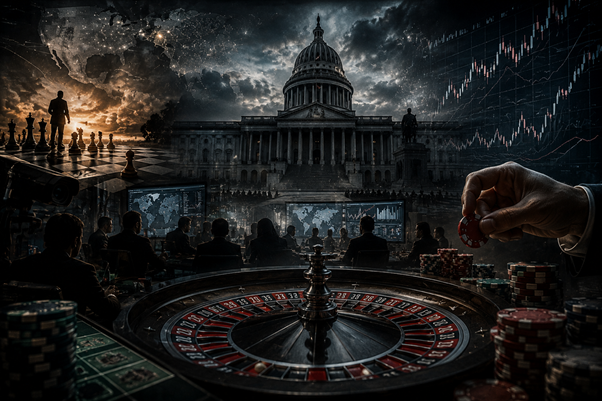
The gambling metaphor, applied with discipline and cognizance of its boundaries, allows documentary filmmakers to render political risk legible to general audiences in a manner that more technical analytical frameworks are unable to achieve. It offers a common language to talk about concealed information, unequal stakes, and irreversible commitment that viewers come to the documentary with without having to be instructed on it — and that filmmakers can build arguments of true complexity on.
According to the Sundance Institute, the documentary films that have had the greatest impact on public understanding of political subjects are those that combine analytical rigour with accessible framing — films that take their audiences seriously enough to make complex arguments without oversimplifying them, using metaphor as a bridge rather than a substitute for genuine analytical engagement.
The gambling metaphor, in the hands of filmmakers who know its strength and its boundaries, is precisely such a bridge — one that the finest political documentaries have crossed in both directions, with the familiar framework of the high-stakes game helping to clarify the unfamiliarity of the political risk.